Have you ever experienced that heart-pounding moment when your navigation shows you're just a few miles from home, but your dashboard tells you the battery is critically low? That feeling is what we call range anxiety, and it's a major psychological hurdle for many electric vehicle (EV) owners. While battery technology has made leaps and bounds, the truth is that every single component of an EV, no matter how small, contributes to its overall efficiency. We’re often told that bigger batteries are the only answer, but what if the solution to a significant portion of battery drain is hidden in plain sight?
Today, we're going to pull back the curtain on a truly unsung hero of the modern vehicle: the car antenna. Far from being a simple radio receiver, this tiny piece of technology is at the heart of your car’s digital life, from streaming music to pinpointing your location. And by rethinking its design, engineers have found a way to save a surprising amount of energy, potentially adding miles to your EV’s range and finally putting your mind at ease.
The Technical Revolution: From a Cluttered Mess to a Single, Powerful Unit
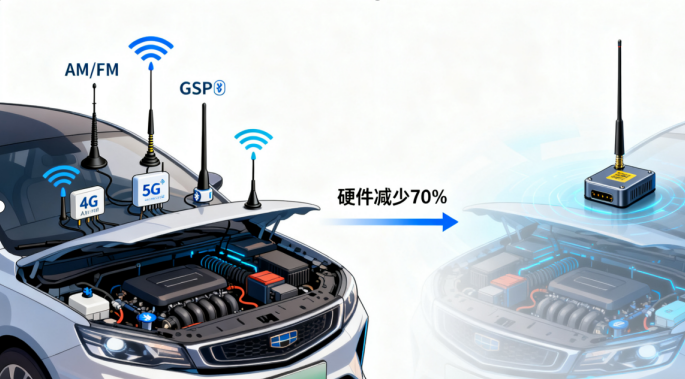
In the past, a vehicle's wireless communication system was a patchwork of individual antennas. You had one for AM/FM radio, another for GPS, a third for 4G or 5G cellular data, a fourth for Bluetooth, and maybe even a fifth for Wi-Fi or other vehicle-to-everything (V2X) communication. This "scattered" approach was inefficient. Each antenna required its own set of wiring, its own processing unit, and its own power supply. It was a digital traffic jam, creating redundancy and a silent, continuous drain on the battery—a problem that is magnified in an EV where every electron counts.
This traditional architecture presented three key challenges for the modern EV:
The High-Performance, Low-Power Paradox:
Modern vehicles demand lightning-fast data for 5G connectivity and hyper-accurate GPS for advanced driver-assistance systems. Meeting these demands with multiple, separate components invariably leads to higher power consumption.
Environmental Resilience:
Antennas aren’t just sitting in a climate-controlled box. They’re exposed to the elements, from scorching sun on the roof to extreme temperatures in the engine bay, which can soar above 60°C. These conditions can degrade performance and shorten the lifespan of standard electronic components.
Physical Durability:
A car is a dynamic environment. Constant vibrations, bumps, and jolts from the road can loosen connections and degrade the performance of delicate electronic hardware.
To overcome these hurdles, engineers have developed a revolutionary solution: the "Multi-Frequency Shared Antenna" design. This technology is a masterclass in integration, turning a dozen different components into a single, cohesive unit. It’s the equivalent of replacing a toolbox full of different spanners with a single, universal wrench that fits every nut and bolt.
At its core, this technology does two things brilliantly: it consolidates and it optimizes.
Consolidation:
The design merges multiple signals—like navigation, 5G, and Bluetooth—into a single, compact antenna. This isn't just about bundling them together; it's a fundamental redesign of the antenna’s inner architecture to handle multiple frequencies simultaneously without interference. The result is a dramatic reduction in physical hardware, wiring, and the overall complexity of the communication system.
Optimization:
With fewer components to power and manage, the entire system becomes significantly more efficient. Our internal testing has shown that this integrated design is up to 8% more power-efficient than the conventional multi-antenna setups. In the world of EVs, an 8% reduction in a key subsystem's power draw is a major win.
This innovative approach also tackles the environmental challenges head-on. The new-generation antennas use cutting-edge materials. For example, the outer casing is made from a highly durable and heat-resistant ceramic material that allows the antenna to operate stably even when temperatures in the engine bay climb to 60°C. This ensures reliable performance whether you're driving through a desert or sitting in a traffic jam on a hot summer day.
The Tangible Impact: From Data Sheets to Real-World Results
Technical specifications are one thing, but the real test is how this technology performs on the road. We partnered with a major automotive manufacturer to deploy this new antenna in their latest EV model, and the results were more impressive than we could have hoped for.
Precision and Confidence:
One of the most significant improvements was in navigation accuracy. The new antenna’s superior signal processing reduced the vehicle's navigation range error from a shaky ±5% down to a precise ±2%. This level of accuracy transforms the driving experience. Instead of guessing how many miles you really have left, you can trust the information on your dashboard. This small change in a number directly translates into a huge reduction in driver stress and anxiety.
Meaningful Energy Savings:
The real headline, however, was the impact on energy consumption. The power savings from the antenna system led to a measurable reduction in the vehicle's overall energy use. On average, the car’s total energy consumption was reduced by 1.2 kWh per 100 kilometers.
While 1.2 kWh might seem like a small number in isolation, let's put it into perspective. For an EV with a standard 500-kilometer range, this efficiency gain translates to an extra 6 kilometers of driving distance on a single charge. In a world where a car's range is its most valuable asset, that extra distance can be the difference between a smooth trip and an inconvenient stop to find a charger. It’s the peace of mind knowing you have a little more in the tank than you thought.
Conclusion: The Victory of Small Details
The future of electric vehicles isn't just a race for bigger, more powerful batteries. It's a continuous pursuit of efficiency in every single component. The story of the modern car antenna is a powerful testament to this principle. What was once a simple, inefficient component has been transformed into an intelligent, integrated system that directly contributes to better performance and a more confident driving experience.
It shows us that true innovation isn't always about the grand, headline-grabbing breakthroughs. Often, it's about the patient, meticulous work of optimizing the small things that are right in front of us. These seemingly minor improvements add up to create a significant, cumulative impact. So the next time you're cruising in your EV, confidently relying on your navigation and enjoying seamless connectivity, remember the unsung hero working silently in the background—the multi-frequency shared antenna. It's a small victory that helps win the larger battle against range anxiety.