Behind the everyday devices we rely on—smartphones, Wi-Fi routers, Bluetooth headphones, and even complex communication systems like cell towers and satellites—there's a crucial, unseen bridge at work: the RF Coaxial Cable (Radio Frequency Coaxial Cable).
This component is responsible for efficiently transmitting delicate and precious Radio Frequency (RF) signals between different electronic parts. If you view a complex communication system as the body's nervous system, the RF cable acts as the high-speed fiber optic connection between the main nerve centers.
Why can't we just use a standard electrical wire to connect an antenna to a device? The nature of high-frequency signals dictates that ordinary wires act like leaky pipes, causing massive energy loss and being highly susceptible to external interference. This highlights the brilliant design and necessity of the RF Coaxial Cable.
What is an RF Coaxial Cable?
An RF Coaxial Cable is a specially engineered cable designed to transmit RF signals—electromagnetic wave signals typically ranging from 3 kHz to 300GHz—with high efficiency and minimal loss.
In the fields of wireless communication and electronics, the RF cable serves two key functions:
Efficient Transmission: To transfer high-frequency energy from one point to another while minimizing energy losses.
Robust Shielding: Due to its specific structure, it prevents the transmitted signal from leaking out (avoiding interference with other devices) and, crucially, prevents external electromagnetic interference (EMI/RFI) from entering the cable and degrading signal quality.
Simply put, it provides a controlled, enclosed pathway for high-frequency signals to reach their destination safely and intact.
Deconstructing the RF Cable's "Four-Layer Structure"
The term "Coaxial" (Coax) comes from its structure: it contains two conductors that share a single center axis. This concentric geometric design is what guarantees the stability of high-frequency signal transmission and is key to achieving its specific Characteristic Impedance.
The RF coaxial cable primarily consists of the following four essential parts:
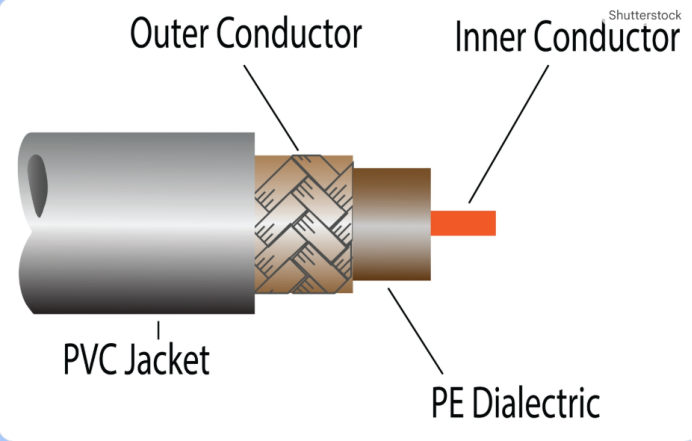
Inner Conductor
Function: Located at the center of the cable, it is responsible for carrying the core RF signal.
Material: Usually solid or stranded, often made of silver-plated copper, or copper-clad steel, ensuring excellent conductivity and good performance related to the Skin Effect at high frequencies.
Dielectric Insulator
Function: Surrounds the inner conductor, providing insulation and maintaining a precise distance between the inner and outer conductors.
Importance: The material of the dielectric (such as Polyethylene (PE), Polytetrafluoroethylene (PTFE), or foam materials) and its permittivity directly determine the cable's characteristic impedance and signal propagation velocity.
Outer Conductor / Shield
Function: Encircles the dielectric, serving as the signal return path and, most importantly, as the electromagnetic shield.
Form: This can take the form of braided copper mesh, metal foil (like aluminum foil), or, in high-performance cables, a solid copper tube, all used to block external noise and prevent signal energy leakage.
Outer Jacket
Function: The outermost protective layer, typically made of PVC or PE, used to shield the internal components from moisture, abrasion, chemicals, and extreme temperatures.
Two Core Parameters: Impedance and Attenuation
To understand the performance of an RF Coaxial Cable, one must grasp its two most critical electrical parameters: Characteristic Impedance and Attenuation.
Characteristic Impedance
Characteristic Impedance is the most critical parameter in an RF system; it describes the opposition a cable presents to a high-frequency current over an infinite length.
Why It Matters: To achieve maximum power transfer in a system, the cable, connectors, and equipment must have perfectly matched characteristic impedances. Any mismatch will cause signal reflections, resulting in energy loss.
Industry Standards:
50\Omega: This is the standard impedance for radio communications, data transmission, and high-power RF applications.
Widely used in video transmission, CATV (Cable Television), and digital baseband video, as this impedance offers lower attenuation.
Attenuation / Insertion Loss
Attenuation is the phenomenon where signal strength decreases with distance as it travels through the cable. It is typically expressed in decibels per unit length
Factors Affecting Attenuation:
Frequency: Higher frequencies result in higher attenuation.
Length: Longer cables result in greater total attenuation.
Cable Type: Larger conductor size and lower loss dielectrics (like foam) result in less attenuation.
An excellent RF engineer must control attenuation within an acceptable range when designing a link, especially in long-distance or high-frequency applications (such as 5 GHz and above).
Conclusion and Next Steps
The RF Coaxial Cable is far more than just a wire connecting two points; it is an indispensable component in high-frequency circuit design. Its unique four-layer structure, precise 50\Omega or 75\Omega characteristic impedance, and the constant pursuit of low attenuation collectively determine the stability and reliability of the entire wireless communication system.
If you have grasped these fundamental principles, the next step is learning how to choose the right cable from the myriad of options based on your specific needs. In our next article, we will dive into a detailed comparison of mainstream RF cable types on the market, such as the common RG series, the high-performance LMR Low-Loss Cables, and the specializedSemi-Rigid Cables used in testing.


