Selecting the right rf coaxial cable is one of the most important decisions when setting up any communication system, whether it’s for professional engineering use, testing environments, or even hobbyist projects. The choice directly affects signal quality, device compatibility, and long-term reliability. The main factors that guide coaxial cable selection include impedance, frequency and attenuation performance, construction and shielding, connector type, and installation environment. At Shenzhen Keesun Technology Co., Ltd., we design and manufacture high-performance coaxial cable assemblies that address all these criteria, ensuring that your systems operate with precision and stability.
Why choosing the right RF coaxial cable matters
Real-world consequences
When the wrong rf coaxial cable is selected, the impact shows up immediately in performance. A mismatch in impedance or poor shielding can lead to significant signal loss, distorted transmissions, or even damage to connected devices. In high-frequency applications such as GPS, satellite communication, or RF testing, even a small error in cable choice translates into unstable results, wasted energy, and reduced efficiency.
Where wrong choices show up
The effects of incorrect coaxial cable selection become visible in several ways. Test labs may notice inconsistent results during calibration. Field technicians might see frequent communication dropouts in base stations or broadcast systems. Over time, organizations face higher maintenance costs due to repeated failures, re-terminations, or replacements. The right selection from the beginning prevents these avoidable problems and helps guarantee dependable signal transmission.
Impedance first: 50Ω vs 75Ω — which one for your system?
Quick rule-of-thumb
Impedance is the starting point of coaxial cable selection. In most RF transmission and communication applications, 50Ω cables are standard because they balance power handling with efficient signal transfer. On the other hand, 75Ω cables are often found in video, broadcast, and some test equipment due to their lower attenuation at specific frequencies. Understanding your device’s design is critical, since using the wrong impedance introduces performance issues.
How mismatch causes VSWR and reflections
An impedance mismatch leads to Voltage Standing Wave Ratio (VSWR) problems, where part of the signal reflects back toward the source. This not only reduces effective signal strength but also risks overheating or damaging sensitive equipment. The simplest way to prevent this is by checking your device’s specifications carefully. If your transmitter or receiver requires 50Ω, the cable must match exactly. At Keesun, we provide clear impedance ratings across all assemblies, giving engineers confidence that their connections will remain stable.
Frequency and attenuation: how cable length and frequency affect performance
Why attenuation rises with frequency and length
Signal attenuation is unavoidable in coaxial cables, but it becomes more critical at higher frequencies and longer runs. Attenuation refers to the signal loss per unit length, usually expressed in decibels (dB). As frequency increases, the inner conductor’s resistance and dielectric losses rise, leading to higher attenuation. Similarly, the longer the cable, the greater the accumulated loss. When selecting a coaxial cable, engineers must balance flexibility, required length, and acceptable signal degradation.
Example: short run GPS vs long cellular feed
For a short GPS antenna connection of less than one meter, micro-coax types such as 1.13 mm or RG-178 offer sufficient performance with excellent flexibility. However, for a long cellular base station feed running several meters, low-loss families such as LMR-200 or RG-213 are better suited. Keesun’s portfolio includes both compact micro-coax solutions for space-limited devices and heavy-duty low-loss cables for extended runs, ensuring reliable performance across applications.
Cable construction and shielding: RG, LMR, micro-coax options
When to pick RG-series vs LMR vs micro-coax
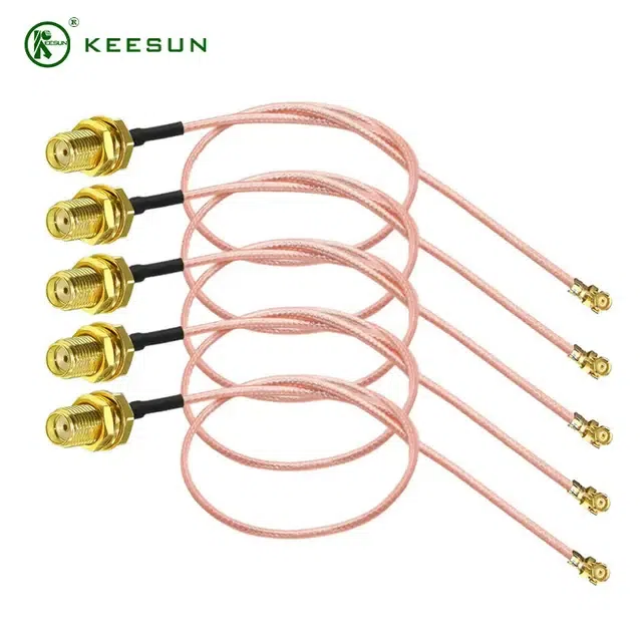
Different families of rf coaxial cable serve different priorities. RG-series cables, such as RG-174 or RG-316, are highly flexible and widely available, making them practical for prototypes or compact equipment. LMR-series cables are optimized for low-loss performance, especially at higher frequencies and longer lengths, making them suitable for telecom, WiFi, and outdoor RF systems. Micro-coax types, such as 0.81 mm or 1.37 mm, are designed for compact devices like GPS trackers or IoT modules, where internal space is limited. Keesun offers all three categories, enabling customers to choose the best fit for their environment.
Shielding levels and EMI concerns
Shielding quality determines how well the cable resists electromagnetic interference (EMI). A single braid shield may suffice for low-frequency or short runs, but in dense environments with multiple transmitters, double-shielded or corrugated designs provide better protection. Choosing higher shielding levels reduces cross-talk and ensures cleaner transmission. For clients with demanding environments, Keesun supplies double-shielded coaxial assemblies that enhance stability and protect against unwanted noise.
Connector selection and mechanical considerations
Common RF connectors to match
The connector is just as important as the cable itself. Common options include SMA for precision RF connections, BNC for laboratory setups, N-type for outdoor and high-power applications, and IPEX for compact devices. Each connector comes in male/female variants and straight or right-angle forms. Selecting the correct connector guarantees compatibility and minimizes the risk of mechanical stress or poor mating.
Weatherproofing and best practices
Mechanical and environmental considerations should not be overlooked. For outdoor deployments, weatherproof connectors and sealing are vital to protect against moisture ingress. The choice between crimp and solder attachment methods also affects durability and repeatability. Adding strain relief prevents damage when the cable is bent or pulled. Keesun emphasizes these best practices in every assembly, ensuring robust performance even in harsh operating conditions.
Quick selection checklist
One-page decision flow
To simplify coaxial cable selection, engineers and buyers can follow a structured checklist:
Confirm impedance requirement (50Ω or 75Ω).
Identify the operating frequency and maximum acceptable attenuation.
Measure the required cable length and select a family that balances flexibility and loss.
Decide on shielding level depending on EMI environment.
Match the connector type, orientation, and assembly method to your device.
This simple process avoids guesswork and ensures a solution tailored to your system’s needs.
When to request a custom assembly
Sometimes, standard catalog parts cannot meet unique requirements. In these cases, a custom coaxial cable assembly is the best solution. When contacting suppliers, provide details such as frequency range, connector type, maximum length, and environmental conditions. Shenzhen Keesun Technology specializes in OEM/ODM cable assemblies, delivering tailored solutions for industries ranging from wireless communication to satellite and IoT.
Conclusion
Choosing the correct rf coaxial cable comes down to balancing impedance, attenuation, shielding, connectors, and mechanical requirements. A precise match ensures your devices work efficiently, signals remain stable, and long-term costs stay low. At Shenzhen Keesun Technology Co., Ltd., we design and manufacture coaxial cable assemblies that perform reliably from 0 to 18 GHz, supporting applications from compact electronics to outdoor communication systems. If you tell us your frequency, connector, and maximum length, we can recommend the most suitable model for your system. Contact us today to discuss your requirements and explore our customizable RF solutions.


