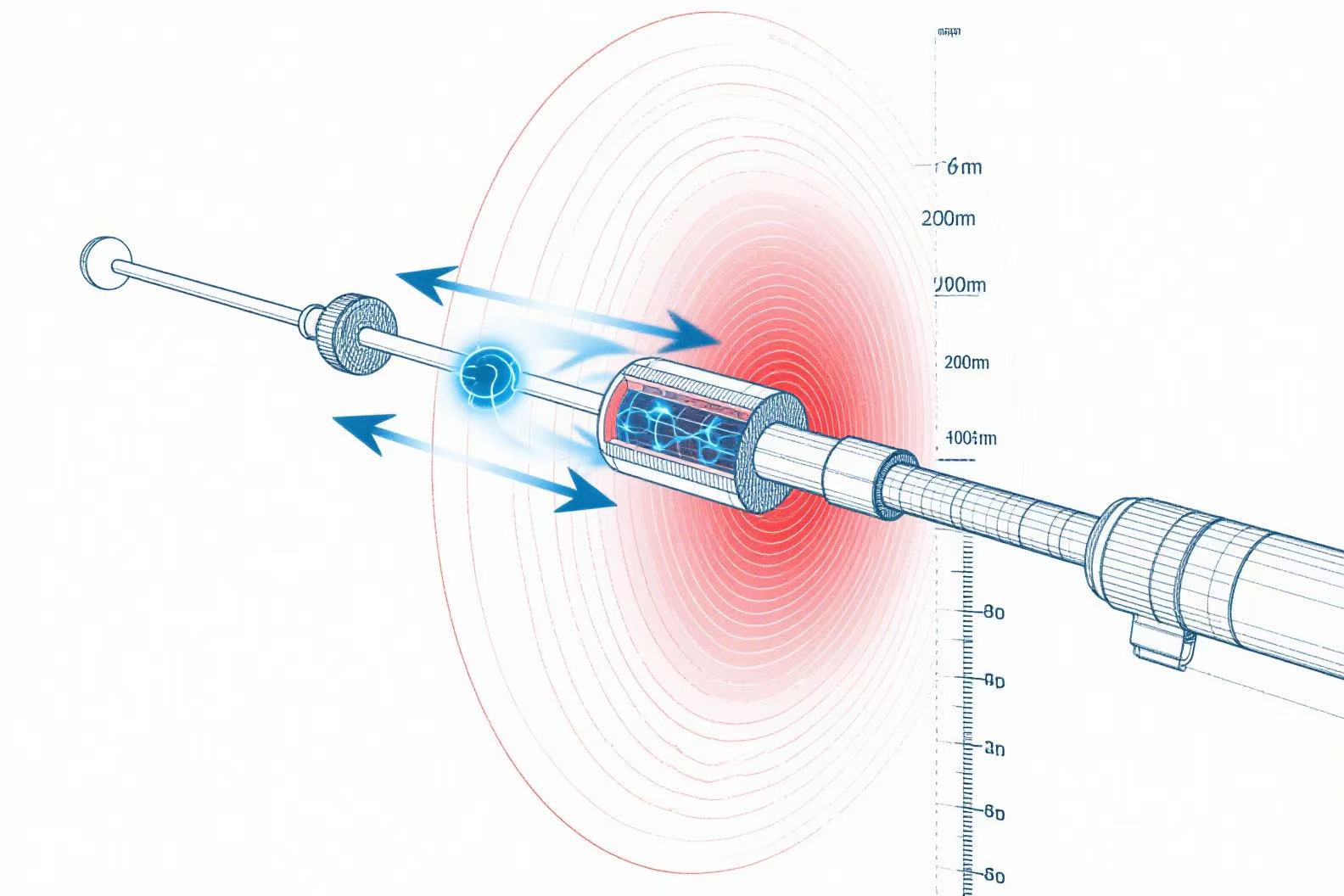
To many, an antenna is a mysterious "black box." It silently transmits and receives invisible signals that connect our world, yet its internal structure is rarely understood. How does it actually convert electrical signals into electromagnetic waves, and how does it capture faint signals from the air?
Have you ever been curious about this small but critical component? Today, we'll step into the shoes of an engineer and "take apart" the antenna. From the most classic designs to the microscopic marvels inside modern smart devices, we'll explore its inner workings and uncover its secrets.
The Foundation: The Basic Dipole Antenna
If you were to look for the most fundamental and classic prototype in the antenna family, it would undoubtedly be the dipole antenna. Nearly all more complex antenna designs are, in some way, derived from it.
Basic Structure: Imagine a metal rod split in the middle, creating two symmetrical parts or "arms." The signal source is connected to the feed point between these two arms. In a classic half-wave dipole, the total length is approximately half of the signal's wavelength (L≈λ/2).
How It Works: When an alternating current is fed to the center of the antenna, electrons oscillate back and forth along the two arms. This acceleration of charges generates an outwardly radiating, ever-changing electromagnetic field—this is the process of radio wave transmission. The reception process is the reverse: electromagnetic waves in the space induce a faint current in the antenna's conductor, which is then decoded by the device.
Its structure is like a pair of open arms, positioned in the most standard posture to embrace and release electromagnetic waves.
An Everyday Sight: The Whip Antenna
The whip antenna, often called a monopole antenna, is one of the most common antenna forms we see in daily life. It can be found on everything from car radios and old walkie-talkies to home Wi-Fi routers.
Relationship to the Dipole: You can think of a whip antenna as "half" of a dipole antenna. It consists of a single conductor (typically λ/4 in length), while the other half is "mirrored" by a conductive surface known as a "ground plane."
A Clever Design: For a car, the metal roof serves as an excellent ground plane. In a router or handheld device, the ground (GND) traces on the internal circuit board fulfill this role. This design significantly reduces the antenna's physical size, making it more practical and compact.
When Every Millimeter Counts: The Mainstream FPC/PCB Antenna
If you open any modern smartphone, laptop, or Internet of Things (IoT) sensor, you'll be hard-pressed to find a protruding antenna rod. So, where did the antenna go? The answer: it has been "drawn" onto the circuit board.
These are PCB (Printed Circuit Board) antennas and FPC (Flexible Printed Circuit) antennas. Using advanced electromagnetic simulation software, engineers etch precisely shaped copper traces directly onto rigid or flexible circuit boards, allowing these traces to function as the antenna.
Highly Integrated: They take up no extra three-dimensional space, enabling the creation of ultra-thin and lightweight devices.
Cost-Effective: As part of the circuit board manufacturing process, their production cost is extremely low, making them ideal for mass production.
High Consistency: Machine etching ensures that the physical parameters of every antenna are highly consistent, leading to stable and reliable performance.
These antennas come in various shapes, often appearing as meandering, fractal, or complex geometric patterns. Every curve and corner is precisely calculated to achieve optimal resonance and bandwidth within a minimal area.
Specialists for Every Task: Other Common Antenna Types
Beyond the types mentioned above, the world of antennas is full of "specialists" designed for specific purposes.
Yagi-Uda Antenna
Commonly known as a "fishbone" antenna, you may have seen it on rooftops as an old TV antenna. It consists of multiple metal elements and is highly directional with very high gain, making it excellent for long-distance, point-to-point communication.
Microstrip Patch Antenna
This antenna looks like a square or rectangular metallic "patch" mounted on a dielectric substrate. It is compact, lightweight, and can be designed to conform to a device's surface, making it ideal for GPS modules, satellite phones, and modern 5G communication equipment.
Conclusion
From a simple metal rod to a complex trace on a circuit board, the internal structure of an antenna is anything but static. There is no single "best" antenna, only the "most suitable" design. Whether it's a dipole, a whip, or a highly integrated PCB antenna, each structure is a product of engineering ingenuity, created to achieve the best communication performance for a specific frequency, size, cost, and application scenario.
Understanding these internal secrets not only satisfies our technical curiosity but also helps us make more informed decisions in future product development and project planning.
Turning Theory into Reality
The world of antennas extends far beyond this. If your project requires high-performance custom internal PCB antennas or external dipoles for specific frequency bands, our team of expert engineers is here to provide you with tailored services.
Shenzhen Keesun Technology Co.,Ltd was founded in Aug of 2012, a high-tech enterprise specializing in various types of antenna and network cable manufacturing.